Beginning around the 1860s, some farmers began exhibiting their prized “coon cats” at the Skowhegan Fair, which is the nation’s oldest consecutively held agricultural fair, dating back to 1818. Here, the predecessors to today’s modern Maine Coon breed competed for the title of Maine State Champion Coon Cat
A female brown tabby Maine Coon named Cosey won what is regarded as the first American cat show, held at Madison Square Garden in New York City on May 8, 1895.1 The Cat Fanciers’ Association’s first stud book and breed registry from 1908 lists the Maine Coon as a foundation breed (listed as “Maine Cats”). The breed is also recognized by the International Cat Association. The Maine Coon was designated as the state cat of Maine in 1985.
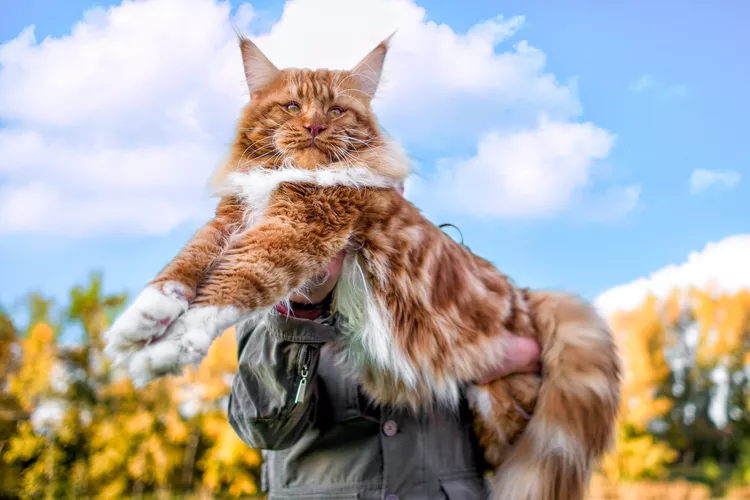
Said to be dog-like in disposition, the Maine Coon cat is intelligent, friendly, and gentle. Laid-back and self-assured, these cats tend to take everything in stride and are great playmates for gentle children. They can usually coexist peacefully with other household pets, including other cats and cat-friendly dogs.
Maine Coons are sociable and inquisitive, and can usually be found wherever the action is in the house, inserting themselves into every interesting situation. Talkative but not overly loud, they express themselves through a variety of soft and melodious meows, chirps, and trills. They are quite trainable cats and enjoy learning tricks, responding well to positive training methods and tasty food treats. Despite the old stereotype, Maine Coons often love water and may play in it, bathe in it, dip their food in it, and even swim.
| Affection Level | High |
| Friendliness | High |
| Kid-Friendly | High |
| Pet-Friendly | High |
| Exercise Needs | Medium |
| Playfulness | Medium |
| Energy Level | Medium |
| Intelligence | High |
| Tendency to Vocalize | High |
| Amount of Shedding | Medium |
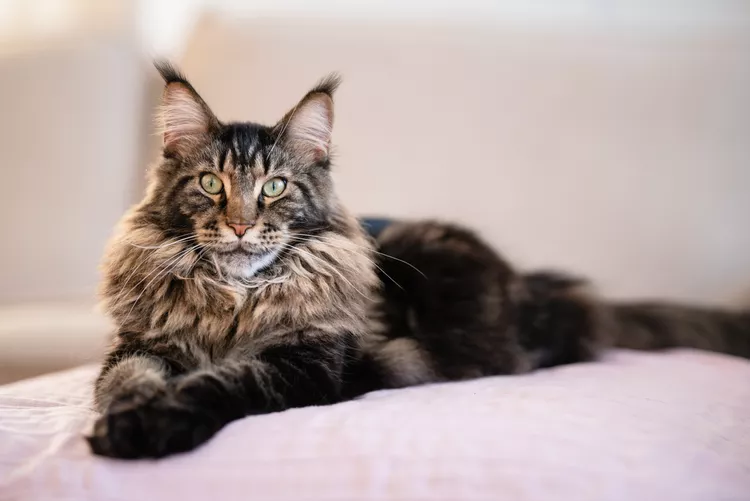
The Maine Coon is a solid, rugged cat that is well-proportioned and balanced despite their massive size. They have muscular, long, rectangular bodies with broad chests. Their large, round paws have tufts of hair sticking up from the toes. The head is slightly longer in length than width, with high cheekbones, a distinctive square muzzle, and large, well-tufted ears. The Maine Coon cat coat is heavy and shaggy with a ruff on the chest. The breed comes in many different colors and patterns except for chocolate, lavender, and the Himalayan (pointed) pattern.
© 2025 Humphries Family Maine Coons.com All rights reserved.
All content, images, and materials on this website are the property of Humphries Family Maine Coons and may not be used without permission.